Recycling and Sustainability — Garden Maintenance Haringey
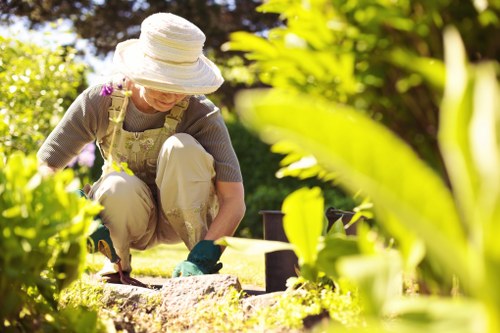
Garden Maintenance Haringey is committed to running an eco-friendly waste disposal area and creating a sustainable rubbish gardening area across domestic and communal green spaces. Our approach focuses on maximising reuse, reducing landfill, and keeping fuels and emissions low while supporting the borough's evolving waste separation systems. We set an ambitious company recycling percentage target and work alongside local transfer stations, charities and community groups to ensure that green waste and reusable materials are diverted from general waste streams.Our Haringey garden maintenance operations are organised to mirror the boroughs approach to waste separation: dry mixed recycling, food waste collection, and dedicated garden waste streams. By sorting at source we increase capture rates for woodchip, leaves, soil-like materials and containers. The team uses clearly labelled sacks and bins at each job to ensure glass, cans, paper, plastics, garden waste and small electrics are separated for recycling or reuse before they ever reach a residual bin.
 We have a measurable recycling percentage target: a short-term target of 65% of total site-waste recycled or reused within 12 months, rising to 75% for green and wood-based materials by the end of year three. These figures cover composting, mulching, chipping branches, pot reuse and material reclamation rather than just municipal collection. Tracking is transparent — each job records quantities of materials diverted to composting, transfer stations or partner charities so we can continuously improve.
To support an eco-friendly waste disposal area we operate with a hierarchy: refuse prevention, reuse, on-site processing (mulching and chipping), local recycling and finally transfer to municipal facilities. Where possible we convert prunings and clippings into mulch on-site, reducing transport and building soil health for clients. Small clean soils are sieved and returned for reuse rather than being classified as waste, and invasive or contaminated materials are segregated and managed through appropriate licensed channels.
 We use a network of nearby local transfer stations and municipal transfer facilities across North London so green materials and recyclable bulky items are handled promptly. Rather than naming one facility, we prioritise transfer hubs that accept segregated green waste, wood, inert soils and recyclable containers — this reduces double handling and shortens haul routes to keep carbon emissions low. Our routing ensures loads go to the correct transfer station for the material type to maintain high recycling yields.
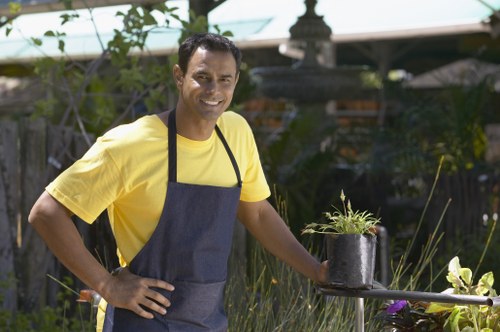
Partnerships with charities and community groups are central to a sustainable rubbish gardening area. We collaborate with local reuse charities, community compost schemes and food-growing projects to donate usable pots, planters, tools and quality topsoil. Items suitable for reuse are cleaned and offered to organisations running community gardens or allotment projects, helping close the loop on garden material reuse and supporting neighbourhood green initiatives.
 Our vehicle policy supports low-carbon transport: the fleet includes low-emission vans and increasingly electric models, alongside pedal-powered cargo for local work where feasible. Switching to electric and hybrid vans, and trialling zero-emission delivery days in denser neighbourhoods, reduces tailpipe emissions and noise. Drivers are trained in eco-driving techniques to lower fuel consumption, and we use route optimisation to keep miles and idle time to a minimum.
We maintain a sustainable rubbish gardening area by integrating on-site solutions such as mobile chippers for woody residues, compost bays for green clippings and designated containers for mixed recyclables. A typical job will separate:
- Garden waste (leaves, grass cuttings, small branches) for composting or municipal green collections,
- Wood and timber for chipping or wood recycling,
- Pots, planters and tools for reuse or charity donation,
- Mixed cans, glass and paper for local recycling streams.